
Modernizing Dealer Inventory Lifecycle Management: From Manual Processes to Automation

Managing dealer inventory today goes far beyond tracking machines. It requires coordinating data, systems, and teams across an increasingly complex equipment lifecycle. Yet for many dealers, critical activities—such as location verification, telematics validation, service readiness, and ownership transitions—still rely heavily on manual checks and cross-system coordination.
As inventory volumes grow and machines move faster between dealers and customers, these manual processes introduce delays, data inconsistencies, and operational risk. This blog explores how a traditionally manual dealer inventory lifecycle can be rethought using real-time data, rule-driven automation, and Salesforce-native workflows to improve accuracy, visibility, and efficiency.
Inside One of Our Client’s Dealer Operations
One of our clients is an authorized John Deere Equipment’s dealer operating across the agricultural and construction equipment ecosystem. Their business spans new equipment sales used equipment sales, and equipment leasing—serving customers with diverse operational and financial needs.
To manage inventory, the dealer maintains Dealer Stock Units (DSUs) in Salesforce. Teams reference machine telematics and MTG-related information available through the John Deere Operations Center to understand equipment location, usage, and status. This information supports inventory tracking, lease management, service readiness, compliance, and dealer-to-customer handover.
Based on DSU status changes, teams manually create inbound (Lot In / Trade-In) and outbound (Lot Out / Sold) requests in Expert Connect. These requests guide manual activities such as data review, cleanup, validation, and preparation, with updates reflected back in Salesforce once the work is completed.
The dealer manages a large and dynamic inventory of machines that move through multiple lifecycle stages—from yard arrival and inspection to leasing, sale, and final delivery. Each machine is equipped with telematics and tracking devices that capture location, usage, and machine health data, which teams rely on to support day-to-day operational decisions.
Challenges Faced by Our Client

1. Manual MTG Verification and Location Updates
Although telematics data was available in the John Deere Operations Center, teams still relied on manual checks and physical verification to confirm machine location and status. Updates to Salesforce were often delayed or missed, resulting in records that did not always reflect the machine’s actual condition or location.
2. Mismatch Between System Data and Physical Status
Because updates depended on manual verification, machine statuses across systems frequently fell out of sync. Machines could appear “on lot” in Salesforce while physically moved out—or vice versa—reducing trust in system data and slowing lifecycle decisions.
3. Service and Lifecycle Request Bottlenecks
Inbound and outbound requests required manual identification, creation, and tracking across systems. This increased turnaround time and added operational overhead for service and operations teams.
4. Manual Data Transfer and Wipe Coordination
Data transfer and wipe activities were coordinated manually, increasing the risk of incomplete, outdated, or non-compliant data remaining on machines prior to dealer or customer handoff.
5. Operational Risk and Compliance Challenges
Heavy reliance on manual processes increased the likelihood of human error and made it difficult to consistently meet John Deere’s data handling and compliance expectations—especially as inventory movement increased.
Our Approach to Solving the DSU Lifecycle Challenge

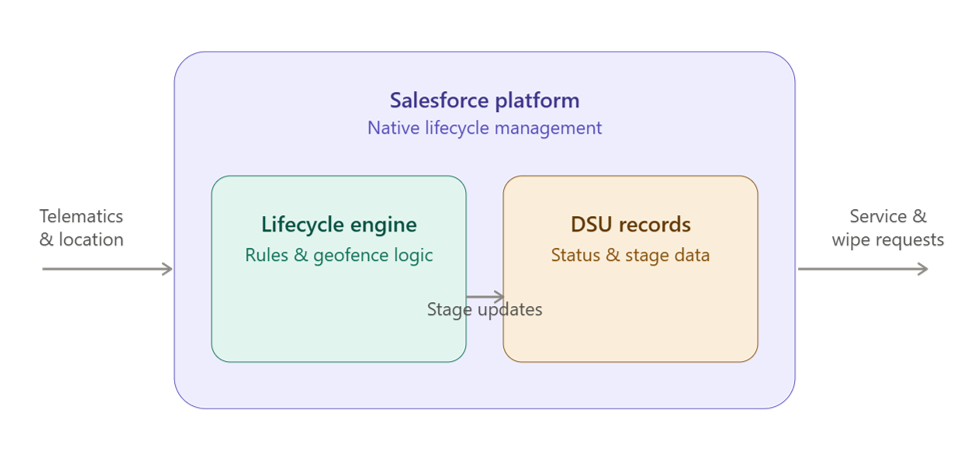
To address these challenges, we implemented an end-to-end equipment lifecycle management solution built natively on Salesforce. The approach focused on replacing manual checks with real-time data, rule-based automation, and centralized visibility—while maintaining alignment with dealer operations and compliance requirements.
1. Real-Time Machine Location and MTG Synchronization
Salesforce was integrated with the John Deere Operations Center to synchronize machine location and MTG status in real time. This eliminated manual verification and ensured Salesforce reflected the current, accurate state of each machine.
Key outcomes:
Automatic location updates in Salesforce
Elimination of manual MTG verification
Reduced mismatches between physical and system data
Improved confidence in lifecycle decisions
Future-Ready Enhancement
In addition to validating MTG status, the solution retrieves details of all telematics devices associated with a machine—creating a foundation for future capabilities such as equipment health monitoring, performance analytics, and proactive service insights.
2. GeoJSON-Based Lot Detection and Geofence Automation
Machine location data is validated against client-defined GeoJSON boundaries to determine whether equipment is on or off the dealer’s lot.
Machines detected within the boundary trigger inbound actions
Machines detected outside the boundary trigger outbound actions
This rule-driven logic removes manual location checks and ensures consistent lifecycle actions.
3. Rule-Driven DSU Lifecycle Orchestration
DSUs now progress automatically through defined lifecycle stages based on machine status and system rules, enforcing a standardized process flow and reducing delays caused by manual handoffs.
4. Automated Service Request Execution
Inbound and outbound service requests are triggered automatically at the appropriate lifecycle stages, eliminating manual initiation and follow-ups and significantly reducing turnaround time.
5. Automated Data Transfer and Wipe Coordination
Data transfer and wipe activities are aligned with lifecycle events and handled systemically, ensuring machines carry accurate and compliant data before dealer or customer delivery.
6. Centralized, Real-Time Visibility in Salesforce
All machine statuses, lifecycle stages, and request states are visible in real time within Salesforce, providing a single, reliable source of truth for dealers and operations teams.
What This Means for Dealers
By replacing manual checks with real-time data and intelligent automation, the DSU lifecycle shifts from a fragmented, manual process to a scalable, transparent, and compliant operation. Dealers gain better visibility, faster execution, reduced risk, and a foundation for future telematics-driven innovation.
Connect With Us
If you’re exploring ways to simplify equipment lifecycle management and reduce manual effort across dealer operations, we’d be happy to connect. At Saleon Consulting, we focus on building practical, scalable solutions that align with how dealer teams actually work.


Comments